
Factors That Decide Your Scrap Car Value
When selling an old car for scrap, several factors can affect how much money you receive for it. While two cars of the same make and model may appear identical, there are a number of factors which auto recyclers will take into consideration. These factors include:
- Weight of the car
- Amount of metal which can be recycled
- Condition of the engine
- Amount of parts you can get out of the car
- Current scrap metal prices
- Distance to tow
- Amount of parts missing.
1. Weight & Metal
The weight of your car plays an important role in determining its scrap value. Most vehicles contain recyclable metals such as steel, aluminium and copper.
Generally, bigger cars will have more metal in them. So an SUV or pickup truck could have a higher base price than a compact hatchback.
However, not all of the car will be paid for. Since they are made up of plastic, rubber, glass, fabric and more, the amount of metal you can get will affect how much you get paid.
- Compacts – These will not have as much metal to recycle and could have a lower base price.
- Sedans – Depending on the size of the car, they will have different amounts of metal.
- SUVs – They can have a higher scrap value due to the larger frames and body work.
- Pickup trucks – Due to their heavy build, they could be worth more.
- Vans – Larger vans can have more metal to recycle than passenger cars.
2. Scrap Metal Prices
Scrap metal prices will vary depending on how much demand is in the market. This means that recycling centres can make more or less money from your car.
Most cars will have a lot of steel in them. Aluminum and copper are also able to be recycled and sold to metal processors and manufacturers.
When scrap metal prices increase, buyers may be able to offer more for your vehicle. However, if they drop in price, you may see a reduction.
For example, if you get an offer of $450 in January, but the price of scrap metals drops a few months later. You may get less for your car, as even though it is in the same condition, the amount they expect to make from your car has dropped.
3. Make, Model & Year
The make, model and year of your car can affect how much you get. This is especially true if parts can be resold.
Auto recyclers will not always just pay for the metal in your car. Sometimes they can salvage usable parts.
For example, A 2015 Honda Civic with a working transmission, undamaged headlights and functional doors could receive a better offer than one with several damaged or missing parts.
Generally, buyers look at:
- Popularity of the model – Parts from popular cars may be in higher demand.
- Year – To determine what generation the car is and what parts will fit.
- Engine – If the engine works, it could have some resale value depending on the model.
- Transmission – If the transmission works, it can increase the value you get.
- Hard to find parts – If parts are hard to find, it can increase buyer interest.
Newer cars do not necessarily mean you will get more. An older car with parts which can be used may be worth more than a newer one with lots of damage.
4. Condition
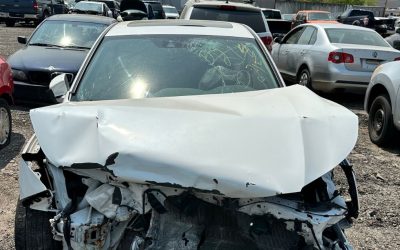
The overall condition of your car can affect how much metal and parts you can get. While a car may not run, it can still have valuable parts. However, if the car has a lot of mechanical or accident damage, you could get less. Buyers generally look at:
Engine & Transmission
If the engine and transmission are working, they could have some resale value. If they are broken, seized or missing, you may get less. Even if your car doesn’t start, other parts may still be usable.
Bodywork & Rust
Small dents and scratches may have little impact on your car’s scrap value. However, if the car has a lot of rust, you may get less. In Ontario, cars can suffer from rust due to salt and moisture.
Battery & Electricals
A working battery, alternator, starter motor and other electrical components may add to your car’s value. Hybrids and electric cars should also be considered, due to their high voltage battery systems.
Wheels, Tyres & Catalytic Converter
Your wheels, tyres and catalytic converter can increase the value of your car. If they are missing, you may get less. Cars with more original components may receive better offers than vehicles with several missing parts.
5. Amount of Parts
The amount of parts your car has can affect the final price.
For example, if one car has all the parts (engine, transmission, battery, wheels and catalytic converter) and one doesn’t (battery, catalytic converter and wheels). You could get a better offer for the one with all the parts. Common parts buyers look for include:
- Engine
- Transmission
- Catalytic converter
- Battery
- Wheels
- Alternator
- Doors
- Bumpers
- Headlights
- Electronics
Even if your car has some parts missing, you can still sell it. Just be sure to mention any parts which have been removed when getting a quote.
Also Read: Can You Scrap a Car With a Missing Engine or Transmission in Ontario?
6. Distance to Tow
The amount you get can depend on how much it costs to collect your car. If it is in an easy to reach place, you will generally get more than if it’s in an underground garage or restricted parking.
Factors buyers may consider:
- Distance – The further away it is to collect, the more it could cost.
- Access – If it is in a tight access area or underground, it may cost extra.
- Condition – If the car doesn’t have wheels or has a locked steering, special equipment may be needed.
- Tow – Some cars require a flat bed or extra handling.
For example, one buyer could offer $500 but charge $75 for towing. While another could offer $450 but offer free collection. This means you would get more money from the second offer. Always look at how much you will actually be getting.
7. Demand for Second Hand Auto Parts
If there is high demand for second hand auto parts, you could get more.
Many car owners will buy second hand parts as they are often cheaper. This means there is a market for second hand parts from old and damaged cars.
Even if your car has a damaged engine, it could have usable doors, mirrors, headlights, wheels, seats and electronics.
However, not all parts will have the same resale value. Buyers will look at the condition, age, fit and demand.
Popular car models may have parts which are easier to sell. As more people will need replacement parts for the same car.
This is why the make, model and year can be important.
How Much Can I Get For My Scrap Car?
There is no set formula for how much you can get for your car. However, the base price will be based on how much metal and parts you can get out of your car. Minus how much it costs to tow and process.
For example:
| Valuation Component | Estimated Amount |
| Recoverable scrap metal | $350 |
| Reusable parts | $200 |
| Total recovery value | $550 |
| Collection and processing costs | $100 |
| Estimated cash offer | $450 |
This means that the buyer expects to get $550 from the car. Minus the $100 it costs to tow and process, you would get an estimated $450.
$350 + $200 = $550
$550 – $100 = $450
These numbers are just examples to show how it works. They are not actual prices you would get in Ontario. The final price will depend on the weight, condition, parts and current market prices.
Get a Cash Offer For Your Scrap Car!
The value of your car depends on how much metal it has, how much it weighs, its condition, how many parts can be used and current market prices. Even if your car doesn’t run, it may still have value due to the recyclable materials and parts. Greenway Auto Recycling buy old, damaged and non-running cars throughout Toronto and the GTA. Get in touch with our team by telling us the make, model, year and condition of your car. We will give you a competitive cash offer. We also offer free towing to make selling your unwanted car easy.