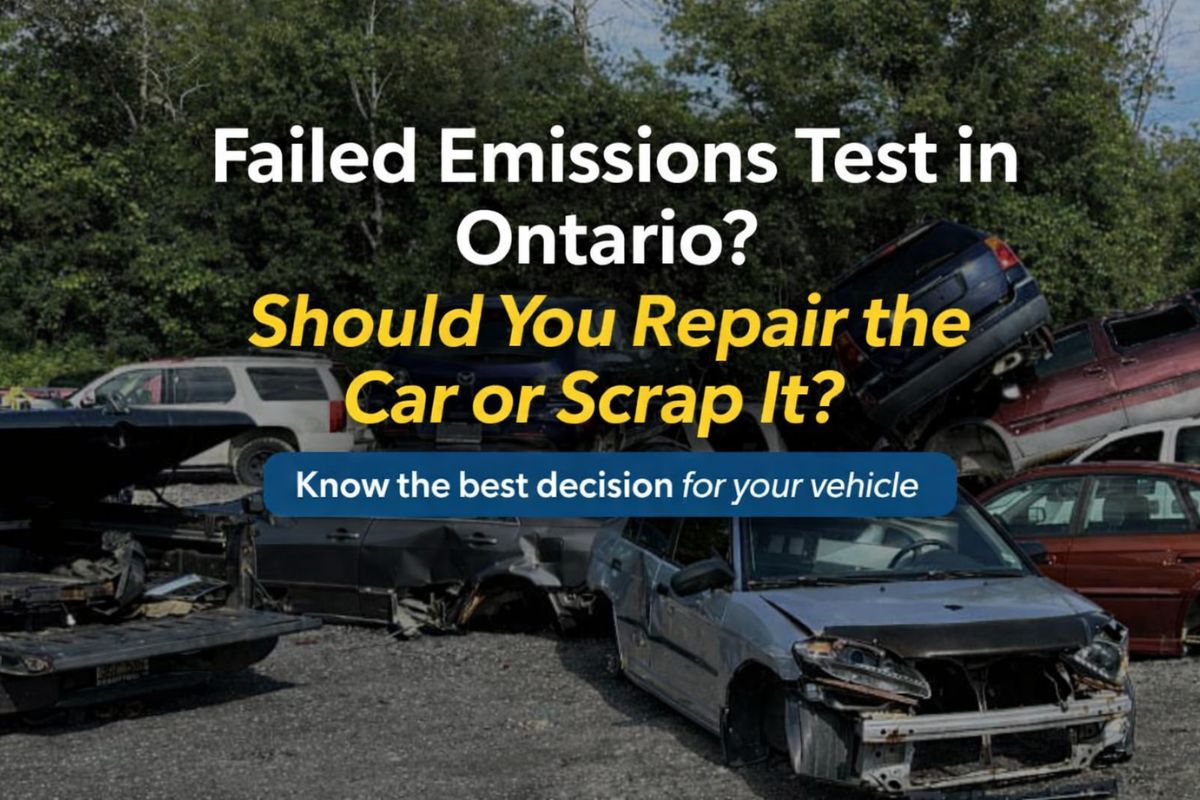
Understand Ontario emissions rules, common repair expenses, and the key factors that help determine when it’s better to fix your vehicle or send it for recycling.
There is a specific kind of sinking feeling that hits when you’re staring at a failed report for your vehicle’s emissions. It usually happens right when you’re already busy or trying to get your registration sorted, and suddenly, you’re faced with a choice that feels like a gamble. Do you sink a few thousand into a car that’s seen better days, or do you finally call it quits?
In Ontario, the rules have shifted quite a bit over the last few years. While the old Drive Clean program for passenger cars is a thing of the past, the province has doubled down on heavy-duty diesel and commercial inspections. If you find yourself in the failed category, you aren’t just looking at a mechanical issue; you’re facing a financial decision. This guide is based on over two decades of hands-on experience in the auto recycling industry to help you figure out if your car is worth saving or if it’s time to let the professionals handle the goodbye.
Understanding the Current Ontario Emissions Testing Rules in 2026
A lot of people are still confused about whether they even need a test. Let’s clear that up first. As of 2026, if you’re driving a standard light-duty passenger car or an SUV for personal use, you generally don’t need a biennial emissions test for plate renewal anymore. However, Ontario still conducts random roadside emissions inspections for heavy-duty diesel vehicles, especially in commercial fleets.
The real weight of the current regulations falls on the heavy-duty diesel emissions Ontario standards. If you operate a large truck, a bus, or a heavy commercial vehicle (over 4,500 kg), the DriveON program is your reality. These tests are rigorous. They look at opacity (how much smoke is coming out) and the On-Board Diagnostic (OBD) system. If your check engine light is on because of an O2 sensor or a clogged Diesel Particulate Filter (DPF), you aren’t passing. Period.
The Cost of Just One More Repair
Many Ontario drivers who receive a failed emissions test quickly discover that the repair costs can escalate faster than expected.
When a vehicle fails, the first instinct is to call the mechanic. But before you book that appointment, you need to look at the vehicle emissions repair costs versus the actual market value of the machine.
Common reasons for failure often involve high-ticket items. Here is a quick reality check on what you might be looking at:
- Catalytic Converters: For many older cars, a new OEM converter can cost anywhere from $1,200 to $2,500.
- DPF Cleaning or Replacement: For heavy-duty diesels, a replacement filter can easily crack the $3,000 mark.
- Sensors and Wiring: Even small things like NOx sensors or wiring harness issues can run you $500 to $900 after labour.
If your car is worth $4,000 and the repair bill is $2,800, you aren’t just fixing a car; you’re over-investing in a depreciating asset. It’s a classic sunk cost trap that many owners fall into, hoping it will be the last major repair for a while.
The Repair or Scrap Decision Matrix
How do you actually decide? At Greenway Auto Recycling, we tell people to use the 60% rule. If the cost of the repair exceeds 60% of what the car would sell for in working condition, it’s usually time to look at scrap car removal options.
When to Repair:
- The vehicle is relatively new (under 10 years old) and has low mileage.
- The failure is something simple, like a loose gas cap or a single faulty sensor.
- You have a sentimental attachment and a very deep pocket.
When to Scrap:
- The car has significant rust or structural issues alongside the emissions failure.
- The parts required for the Ontario Drive Clean replacement standards are no longer manufactured or are on backorder for months.
- The engine or transmission is also showing signs of wear.
The Hidden Benefits of Choosing the Scrap Route
Scrapping isn’t just about getting a “junk” car off your driveway. It’s both an environmental and a financial decision. When a car fails an emissions test, it’s essentially a polluter. By choosing a licensed recycler, you’re ensuring that the heavy metals in the catalytic converter, the lead in the battery, and the fluids in the engine don’t end up in Ontario’s soil or water.
Plus, there’s the “instant cash” factor. Instead of paying a mechanic $100 an hour to poke around your engine, a recycler pays you. You get a free tow, a clean driveway, and a cheque that can go toward a down payment on a vehicle that actually passes inspection.
What Happens During a Scrap Car Pick-up?
If you’ve decided that enough is enough, the process is actually way simpler than the repair route. You don’t need a safety certificate to scrap a car. You just need the ownership (the green slip).
- Get a Quote: Provide the year, make, and model. Be honest about the catalytic converter—that’s where a lot of the value lies.
- Clear the Junk: Take out your personal items and remove the license plates. You’ll need to return those to ServiceOntario.
- The Handover: The tow truck arrives, you sign the back of the vehicle ownership, and you get paid on the spot.
Final Thoughts
Failing an emissions test doesn’t have to be a nightmare. It’s just a signal that your vehicle has reached the end of its efficient life cycle. If you are struggling with a failed emissions test Ontario report and the repair quotes are making your eyes water, it might be time for a fresh start.
At Greenway Auto Recycling, we’ve spent over 20 years helping Ontarians navigate this exact crossroad. We believe in honest valuations and making the process as painless as possible. If your vehicle has failed an emissions test and the repair cost is too high, scrapping it with a licensed recycler like Greenway Auto Recycling can be the simplest solution. We’ll handle the heavy lifting and make sure your old vehicle is recycled responsibly while putting money back in your pocket.